
How to Calculate Population Standard Deviation — Easy Formula & Steps
Understanding variability is central to measurement, decision-making and program evaluation. This article explains how to calculate population standard deviation clearly, practically, and with relevance across fields — from academic research to state-level program evaluation, rural development projects, and women empowerment schemes. Readers will find historical context, step-by-step instructions, worked examples, software implementation tips, policy applications, comparisons with alternative measures, documented successes, common challenges, and future directions. Repeated references to how to calculate population standard deviation are included to reinforce mastery and support search engine relevance.
What is Population Standard Deviation and why it matters
Population standard deviation quantifies how spread out values are in an entire population. When analysts want to describe the dispersion of a complete dataset (for example, the incomes of all households in a district), they calculate the population standard deviation. Learning how to calculate population standard deviation helps ensure accurate interpretation of program impacts, state-wise benefits, and differences across regions. In monitoring social welfare initiatives, knowing the dispersion around central outcomes (not just averages) prevents misleading conclusions and better guides resource allocation.
A short history: Origins and development of the concept
The idea of measuring spread evolved alongside the growth of probability and statistics. Early mathematicians and astronomers used variance-like concepts to quantify observational errors. Over time, formal definitions emerged: variance as the mean squared deviation, and the standard deviation as its square root. The work of Karl Pearson in the late 19th and early 20th centuries standardized terminology and formulas that underpin modern instructions on how to calculate population standard deviation. The historical lineage shows the tool’s deep roots in scientific measurement and its contemporary extensions into policy evaluation and social science.
Objectives when calculating population standard deviation
Every calculation of dispersion serves one or more objectives: to summarize variability, to compare distributions across states or schemes, to detect outliers, or to inform modeling assumptions. When agencies evaluate women empowerment schemes or regional welfare programs, they ask not only whether the mean outcome improved, but whether benefits were equitably distributed. The objective of explaining how to calculate population standard deviation is therefore not just computational — it is interpretive: to transform raw numbers into actionable insight for policy framework, program targeting, and evidence-based scaling.
The mathematical definition — precise and practical
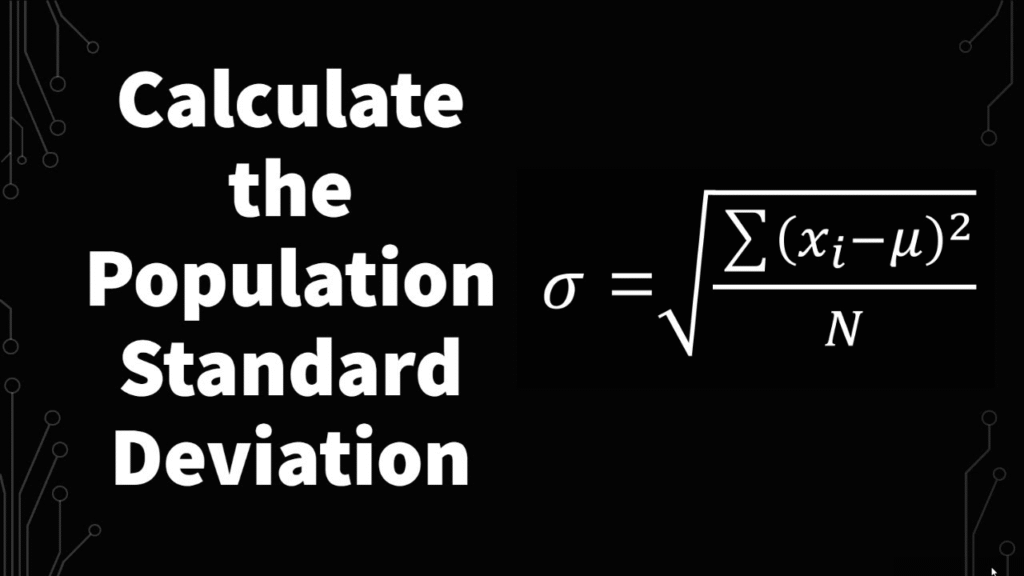
At its simplest, population standard deviation (σ) is defined as the square root of the average squared deviation from the population mean. Formally:
σ = sqrt( (1/N) * Σ (xi − μ)² )
Where:
- N is the population size,
- xi are individual observations,
- μ is the population mean.
Understanding how to calculate population standard deviation begins with this definition: calculate the mean of the population, compute each observation’s deviation from that mean, square those deviations, sum them, divide by N, and take the square root.
Step-by-step procedure: A practical walkthrough
- Collect the full set of values that constitute the population of interest.
- Compute the population mean (μ) by summing all values and dividing by N.
- For each value xi, compute the deviation (xi − μ).
- Square each deviation to remove negative signs and emphasize larger departures.
- Sum the squared deviations across all observations.
- Divide the total by N to get the population variance.
- Take the square root of the variance to return to the original units — that result is the population standard deviation.
This stepwise plan is the core of how to calculate population standard deviation, and it applies whether the field is demography, economics, education, or program monitoring.
Worked example: Household income in a small dataset
Consider five households with incomes (in units): 20, 25, 30, 35, 40. N = 5. The population mean μ = (20+25+30+35+40)/5 = 30. Deviations are −10, −5, 0, 5, 10. Squared deviations are 100, 25, 0, 25, 100. Sum = 250. Divide by N: 250/5 = 50. Square root: sqrt(50) ≈ 7.071.
This example demonstrates how to calculate population standard deviation concretely: the result (≈7.07) tells us the average distance from the mean income in this population, and it forms the basis for comparing variability across regions or before-and-after program implementation.
Population vs sample: Why the distinction matters
In practice, analysts often work with samples rather than whole populations. When the dataset represents an entire population, use the population standard deviation formula. If the dataset is a sample intended to estimate population properties, use the sample standard deviation (which divides by N−1) to correct bias. Confusing the two leads to incorrect inferences. Clear understanding of how to calculate population standard deviation includes knowing when the population formula is appropriate and when sample adjustments are required.
Common pitfalls and how to avoid them
Missteps happen even for experienced analysts. Common pitfalls include:
- Using the sample formula when the data represent the full population,
- Forgetting to square deviations,
- Mixing up population size definitions (e.g., inadvertently excluding subgroups),
- Relying on rounded intermediate values which reduces precision.
Avoid these by following the step-by-step method for how to calculate population standard deviation, documenting every step, and using software or spreadsheets with full precision until the final result.
Implementation in spreadsheets and programming languages
Modern practitioners rarely compute standard deviation by hand for large datasets. Spreadsheets and software have built-in functions. In Excel:
- Use STDEV.P(range) to compute population standard deviation.
In Python with NumPy:
- Use np.std(array, ddof=0) where ddof=0 ensures the population formula.
In R:
- Use sd(x) * sqrt((length(x)-1)/length(x)) for population standard deviation, or compute sqrt(mean((x – mean(x))^2)) directly.
These examples show practical ways to implement how to calculate population standard deviation accurately and efficiently across common tools.
Interpreting the result: Units, context, and meaning
Standard deviation shares units with the original data, which makes it intuitive: if incomes are in thousands of dollars, the standard deviation is also in thousands. Interpretation depends on context: a standard deviation of 5 could be large in a dataset of small numbers and trivial in a dataset of large magnitudes. When evaluating state-wise benefits or comparing outcomes across regions, always contextualize the standard deviation relative to the mean or median to gauge relative inequality or dispersion.
Using standard deviation in policy evaluation
Statistical dispersion is critical when assessing the success of social welfare initiatives. Suppose a state implements a rural development subsidy; measuring changes to the mean income is useful, but measuring changes in the population standard deviation reveals whether the subsidy narrowed or widened income gaps. Mastering how to calculate population standard deviation thus helps policymakers determine not just whether outcomes improved, but whether progress was inclusive — a critical lens for women empowerment schemes and equitable program design.
Measuring equity: Standard deviation and inequality
Standard deviation complements other inequality measures. While Gini coefficients quantify relative inequality, standard deviation shows absolute dispersion. For policymakers assessing state-wise benefits across districts, combining both approaches gives a fuller picture: a falling mean with an increasing standard deviation could signal growing disparities. The practical art of how to calculate population standard deviation thereby supports nuanced policy frameworks.
Case study: Evaluating a women empowerment scheme (hypothetical but illustrative)
Imagine a program that provides small grants to women entrepreneurs across several districts. Baseline and follow-up income distributions can be fully enumerated in pilot areas, enabling calculation of population standard deviation at both time points. If the population standard deviation decreases post-intervention, benefits are more evenly distributed; if it increases, some beneficiaries may be pulling away. Clear application of how to calculate population standard deviation aids program managers in refining targeting rules and complementary capacity-building to improve equitable outcomes.
Regional impact and state-level analysis
When governments compare state-level benefits, standard deviation helps identify which states show the most consistent outcomes. A low population standard deviation in a state’s educational attainment suggests homogeneous access across communities; a high standard deviation indicates disparities requiring targeted interventions. Analysts who can show how to calculate population standard deviation and interpret it alongside regional indicators strengthen the evidence base for reallocating resources or adapting policy frameworks to local needs.
Comparing programs: Standard deviation as an evaluative metric
Comparative evaluation of rural development projects or social welfare initiatives can incorporate standard deviation as a performance metric. Two programs with similar mean gains may differ widely in dispersion: the one with lower population standard deviation achieved more uniform results. Including how to calculate population standard deviation in monitoring frameworks creates incentives for program designers to prioritize inclusive, broad-based impact instead of concentrating benefits among a few.
Success stories: When measuring dispersion changed policy
There are many instances where looking beyond averages changed policy choices. For instance, when analysts measured dispersion in school test scores across districts, a large standard deviation in some states triggered targeted investments in teacher training and infrastructure. Similarly, a detailed analysis of income distributions in rural development programs that included population standard deviation led to redesigned subsidy tiers to better reach marginalized households. These successes underscore the value of mastering how to calculate population standard deviation as part of responsible program evaluation.
Challenges in real-world data
Real datasets are messy. Missing values, measurement error, and nonresponse bias all affect dispersion estimates. When calculating population standard deviation for program monitoring or policy analysis, analysts must address these problems through imputation, cleaning, or sensitivity analysis. Documenting assumptions about data quality and applying robust methods in how to calculate population standard deviation increases credibility and avoids misguided policy actions.
Robust alternatives and complementary measures
Standard deviation is sensitive to outliers because of squaring deviations. In contexts with heavy tails or extreme values, consider complementary metrics: median absolute deviation (MAD), interquartile range (IQR), or trimmed standard deviation. Use these in tandem with population standard deviation so that program evaluations — including those for women empowerment schemes or social welfare initiatives — reflect robust patterns of dispersion and are not driven by a few extreme cases.
Communication: Translating statistical dispersion to stakeholders
Communicating dispersion to non-technical policymakers requires care. Translate the numeric result into plain language: instead of saying “σ = 12,” explain that “the typical household diverges from the average income by about 12 units.” Use visual tools — histograms, boxplots — to illustrate dispersion. When writing policy briefs about state-wise benefits, a clear explanation of how to calculate population standard deviation and what it implies for equity makes the analysis actionable.
Automation and dashboards: Operationalizing dispersion measurements
Many government agencies now automate indicators on live dashboards. Embedding a population standard deviation calculation into routine monitoring allows near-real-time assessment of equity. For example, as beneficiaries are enrolled in a rural development scheme, an automated pipeline can compute the population standard deviation of a targeted outcome and flag widening dispersion. Knowing how to calculate population standard deviation simplifies setting up these automated checks and thresholds.
Advanced topics: Weighted populations and stratified analyses
Not all populations are uniform. When groups have different weights — for instance, if districts differ in household counts — compute a weighted population standard deviation. Similarly, stratify by gender, caste, or geography when evaluating women empowerment schemes or social welfare initiatives. Weighted formulas preserve representativeness and ensure the result answers the right policy question. The core question of how to calculate population standard deviation extends naturally to these advanced but practical cases.
Legal and ethical considerations in public data use
Using population-level data raises confidentiality and privacy concerns. When calculating population standard deviation from administrative records, ensure anonymization and follow ethical guidelines. Aggregate statistics like standard deviation are generally safe to publish, but when small counts are involved, be cautious. Ethical stewardship of data ensures that efforts to learn how to calculate population standard deviation do not compromise individual rights.
Comparing standard deviation across time: longitudinal interpretation
Time-series comparisons of dispersion reveal important trends. For example, over several years, a falling population standard deviation in healthcare access across states could indicate successful policy harmonization. Conversely, a rising dispersion may warn of uneven implementation. Analysts should adjust for structural changes and maintain consistent definitions to ensure that comparisons of how to calculate population standard deviation across time remain valid and informative.
The role in research: hypothesis testing and modeling
Standard deviation underpins many statistical techniques. It feeds into z-scores, confidence intervals, and hypothesis tests. Researchers modeling the effects of a policy often begin by characterizing the outcome distribution via mean and standard deviation. Knowing how to calculate population standard deviation is therefore foundational for rigorous quantitative research and for deriving inferential statistics that guide evidence-based policy.
Software reproducibility and documentation
Reproducibility is essential. When producing reports on program performance or state-wise benefits, include documented code and data processing steps that show how the population standard deviation was computed. This transparency builds trust with stakeholders and allows third-party validation. Use version control and automated notebooks so that your calculations of how to calculate population standard deviation can be audited and replicated.
Cost-effectiveness and resource allocation implications
Dispersion measures influence resource allocation decisions. A program that reduces average poverty but increases dispersion may require additional targeting to achieve equitable outcomes. Calculating population standard deviation enables cost-effectiveness analyses that factor in not only mean gains but distributional fairness. Incorporating dispersion into the appraisal of public investments strengthens alignment with social welfare objectives.
Cross-country and cross-state comparisons: standardization matters
Comparing population standard deviation across jurisdictions requires standardization. Differences in currency, measurement units, and survey design can distort comparisons. Use normalized measures (like coefficient of variation) to contextualize the absolute standard deviation. Still, the fundamental skill of how to calculate population standard deviation remains the starting point for any comparative analysis.
Limitations: When standard deviation misleads
Standard deviation summarizes dispersion but does not reveal the shape of the distribution. Two regions can have the same standard deviation but very different distributions (one symmetric, another skewed). Complement standard deviation with shape descriptors (skewness, kurtosis) and visualizations. Recognizing the limitations of how to calculate population standard deviation prevents overreliance on a single metric.
Practical checklist for analysts
When preparing to compute and report population standard deviation:
- Confirm whether you have a full population or a sample.
- Clean and validate the data.
- Decide on weighting if required.
- Use precise computational functions to avoid rounding errors.
- Pair standard deviation with complementary measures and visuals.
- Document code and assumptions for reproducibility.
Following this checklist ensures that your efforts to calculate how to calculate population standard deviation yield robust and policy-relevant insights.
Future prospects: Big data and AI-enhanced measurement
As governments and researchers collect richer data (remote sensing, administrative transactions), standard deviation will remain relevant but will interact with new analytics. Machine learning models incorporate dispersion implicitly; however, explicit reporting of population standard deviation preserves interpretability — a crucial advantage in policy contexts. The future will likely see more real-time computation of dispersion across massive datasets, but the fundamental steps of how to calculate population standard deviation will remain central to meaningful interpretation.
Integrating standard deviation into the policy framework
To institutionalize equity-oriented monitoring, agencies should embed dispersion metrics into performance indicators. For example, conditional cash transfer programs could add population standard deviation of beneficiary income as a co-primary outcome. Doing so aligns incentive structures toward inclusive results and improves accountability for state-wise benefits and rural development goals. Thus knowing how to calculate population standard deviation contributes directly to better governance.
Cross-sectoral applications: education, health, agriculture
In education, standard deviation of test scores highlights learning inequality across schools or districts. In health, dispersion in immunization coverage can signal pockets of vulnerability. In agriculture, variability in yield across farms may indicate differential access to inputs. Across sectors, calculating population standard deviation allows program managers to identify variability hotspots and design targeted interventions, whether in women empowerment schemes or broader social welfare initiatives.
Capacity building: training teams to interpret dispersion
Analysts and program officers need training not just to run the calculation but to interpret results responsibly. Workshops that focus on practical demonstrations of how to calculate population standard deviation, coupled with policy case studies (e.g., state-wise program evaluation), help build institutional capacity. Pair numerical training with communication skills to translate findings for non-technical audiences.
Policy trade-offs and decision-making
When dispersion metrics reveal inequalities, policymakers must choose interventions that balance efficiency and equity. Reducing dispersion may require redistributive measures that affect average outcomes. Clear understanding of how to calculate population standard deviation and its policy implications enables informed debates about trade-offs and the selection of complementary measures such as targeted subsidies or capacity building.
Conclusion: Why mastering this skill matters
A simple numeric value — the population standard deviation — carries powerful meaning when used thoughtfully. Whether assessing the impact of rural development programs, measuring state-wise benefits, or evaluating women empowerment schemes, the ability to compute and interpret dispersion transforms data into actionable guidance. Mastery of how to calculate population standard deviation equips analysts and policymakers to design fairer, more effective, and evidence-driven interventions.